To experiment with all that I had researched, we split our work into four different processes – Line, Tone, Shape and Texture. Each of these was an extremely basic premise to go off, but that gave me a lot of freedom and flexibility in designing my work.
Line
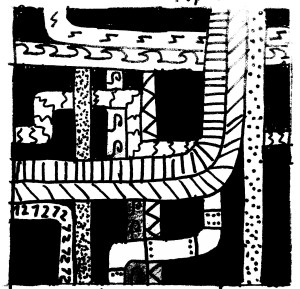
The first design I did involved lines, and it created an effect similar to those of interlocking pipes. To start out with line, I wanted to create an intricate design, highly involving lines that overlapped and intersected. In order to make it so you could tell the line were intersecting and curving as I intended, I decided to give them some width so that this effect was able to be seen. Since I wasn’t working with colour on any of these tasks, I wasn’t able to use it to differentiate each of the lines from each other. I then decided to give each line a unique pattern so that they could be identifiable from each other, the patterns themselves involving use of lines in order to add another level of depth and complexity to my work.
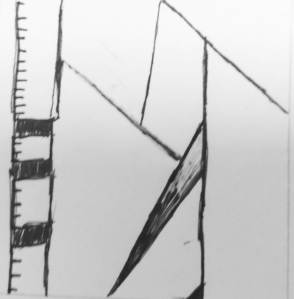
For this, I just used some basic straight lines. This was a good way for me to experiment with angles, which lead me to be inspired to use different angles and rotation in my work.
For this design, I was experimenting with tone. In order to experiment with different types of shading, I decided to draw some kind of non-descript creature. This meant that I had something completely new to work with, which meant I had a completely new way to shade. This gave me some insight into how I could use good shading.
For my second Tone piece, I experimented a lot with depth. I didn’t want to focus too much on something too artistic, so I drew some basic shapes to make a simplistic cliff face. With that, I could see different types of angles and levels of depth and the different ways that they may be shaded.
In my first Shape experimentation, I drew a lot of basic shapes, including circles, squares and triangles. This was very general shape experimentation, and I developed it further by drawing on lines connecting each of the vertices of the shapes, which allowed me to make even more shapes between them.
With my second shape experimentation, I first drew a grid of equal squares. With this, I was able to use triangles of different shades to show different types of shapes and shading. For example, I used more and less lines for cross-hatching to show different levels of shading. To experiment with the different ways that I could use shape, I attempted to create something that looked like a face using the grid.
In the Texture experimentation, I tried to keep things more natural and draw plant life for the designs. For this one, I used a cotton bud dipped in ink in order to get a natural, round, textured shape. I used this by compiling all the types of shapes together so it looked like a set of flowers, and then I used pen to draw lines between them and bring them together to resemble a rosebush.
For my second Texture experimentation, I used a lot of ink for the full design. The primary tool that I used alongside it was a wooden cocktail stick with a blunt tip. This gave me a fairly simplistic tool to use, but by varying the pressure and angles that I used, I was able to change it so that I could consider lots of different shapes and angles using just the circle.
 SamFishwick2018UALED